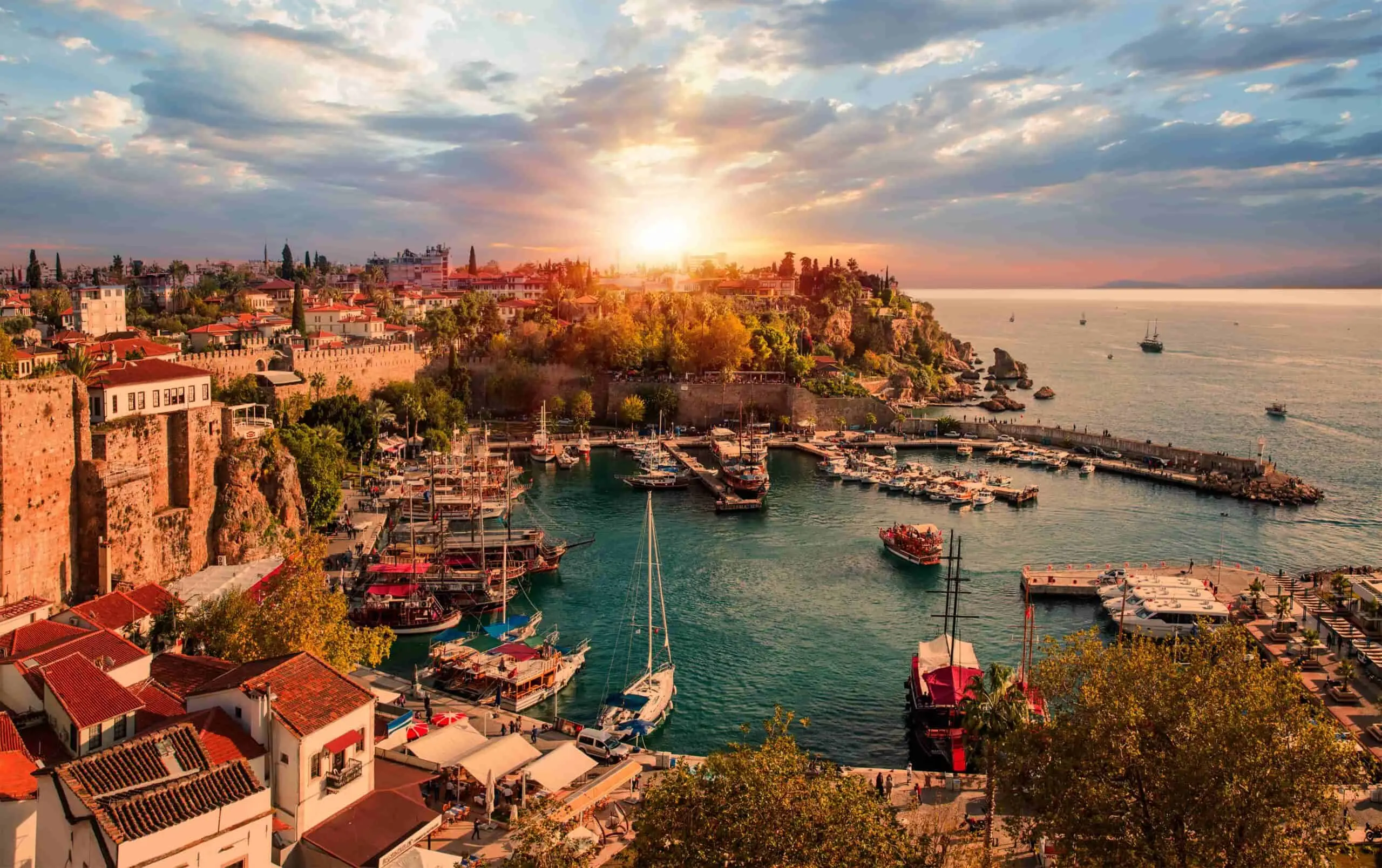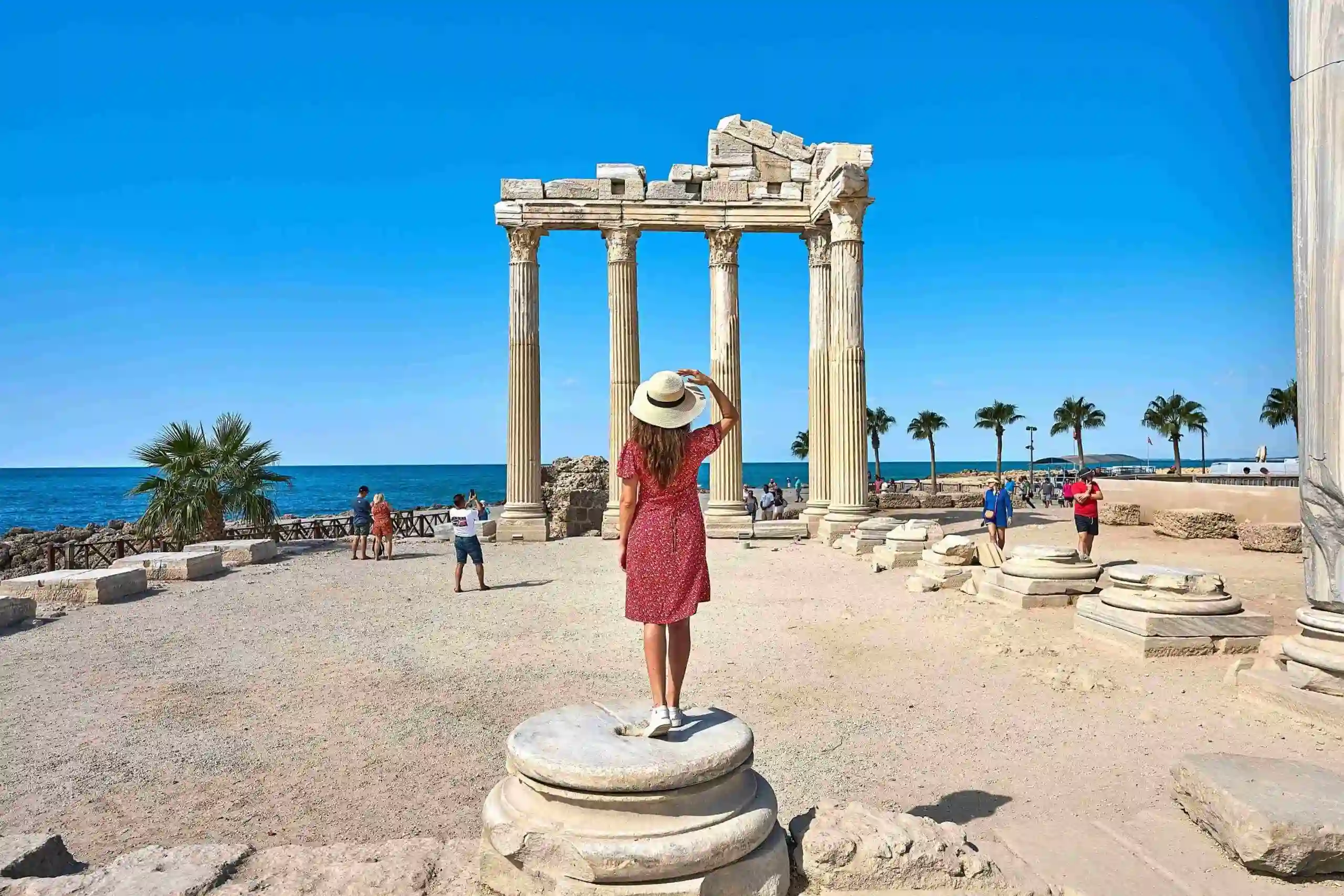
The old harbour at Kaleiçi has Roman stonework at its base, Byzantine walls on top of that, and Ottoman-era houses built against those walls. Three civilisations, stacked. And that is just the harbour.
Most visitors come to Antalya for the coast. But the city has changed hands between empires more than a dozen times over 2,000 years, and each one left something standing. If you know what you are looking at, a walk through Kaleiçi Old Town becomes a walk through the history of the western Mediterranean world.
This guide to the history of Antalya covers the major empires that shaped the city, from its founding by a Hellenistic king to its incorporation into the Turkish Republic, and points out exactly what each era left for you to find today.
—
Who Founded Antalya? The Attalid Kingdom of Pergamon
Antalya was founded around 159 BC by Attalus II Philadelphus, the king of Pergamon, a prosperous Greek kingdom in western Anatolia. He was looking for a Mediterranean harbour to anchor his naval operations, sent surveyors along the coast, and received back a report that this particular bay, sheltered by high cliffs and fed by fresh water from the mountains, was exceptional. He named the city Attaleia, after himself.
The name stuck. Over two thousand years of language change, Attaleia became Antalya.
Attalus II died in 138 BC. His successor, Attalus III, left the entire kingdom of Pergamon to Rome in his will when he died in 133 BC, an act still debated by historians. Whether it was a genuine bequest, a political calculation, or forced under duress, the result was that Rome inherited Antaleia without a siege.
**What survives**: Almost nothing is visible from the Attalid period specifically, though the basic layout of the harbour district follows the original Hellenistic plan. The city’s position and its street pattern below Kaleiçi Old Town reflect those early foundations.
—
Roman Antalya: Hadrian’s Gate and the Imperial City
Under Rome, Antaleia became a major port on the Via Sebaste, the Roman road system connecting the Anatolian interior to the coast. Goods, soldiers, and emperors moved through it. The city grew, built walls, temples, a theatre, and a colonnaded street.
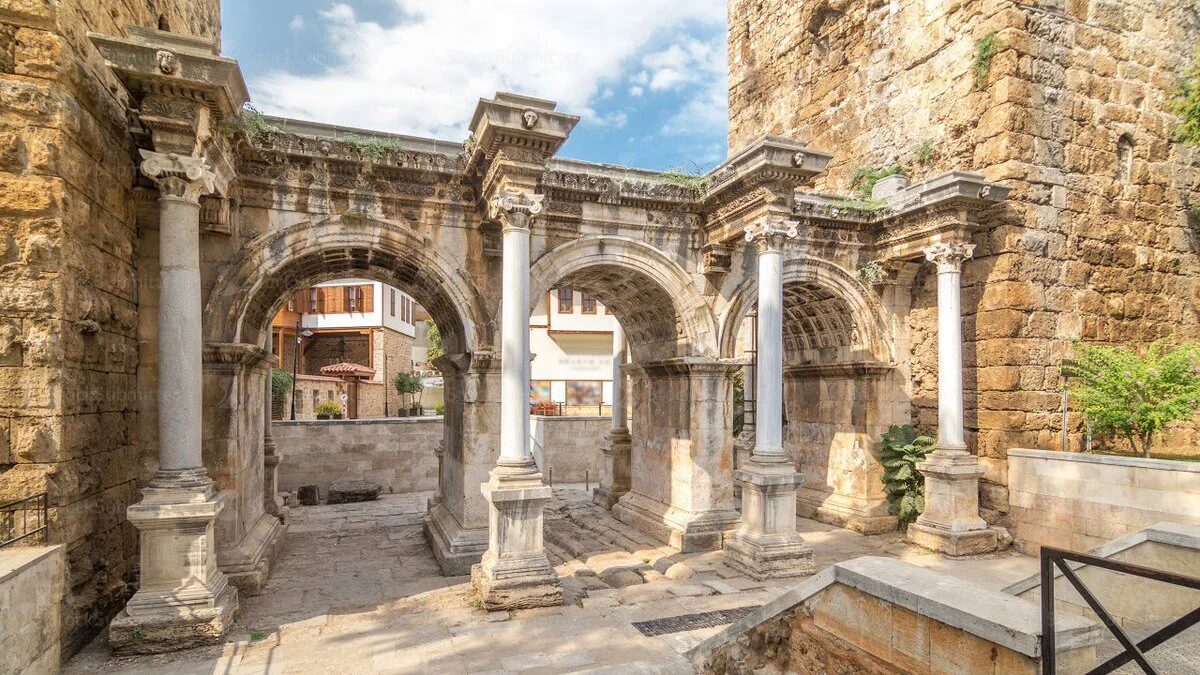
The most visible Roman legacy is **Hadrian’s Gate**, a triumphal arch built in 130 AD to mark the visit of Emperor Hadrian to the city. Three arched passageways, marble columns, and carved reliefs. It was built by the city as a gesture of honour to the Emperor, and it still stands at the entrance to Kaleiçi today, largely intact.
Two other Roman structures are worth noting.
**Hıdırlık Tower**, at the southwest corner of the old city walls, is a solid cylindrical Roman tower from the 2nd century AD. Its exact original function is disputed, it may have served as a lighthouse, a tomb, or both. It is still standing and still facing the sea.
**The Kesik Minare** (Truncated Minaret, or Broken Minaret) is a ruin that tells the full history of the city in one building. It started as a Roman temple, most likely dedicated to Artemis. The Byzantines converted it into the Church of the Virgin Mary. The Seljuks converted it into a mosque. A fire in 1896 destroyed the upper floors. What stands today is a layered ruin, each level from a different civilisation.
> A visitor on one of our city tours stopped at the Kesik Minare and asked why it was described as both a mosque and a church in the same guidebook. The honest answer is that it was neither for most of its history and both at different points. The Roman columns are still visible in the lower section. Standing there, you can touch 2,000 years of religious history in one ruin.
Our Antalya City Tour covers Kaleiçi Old Town, Hadrian’s Gate, and the harbour area with a licensed guide who can explain what you are actually looking at, not just the names on the signs.
—
Perge, Aspendos, and Termessos: The Roman Cities Near Antalya
The Roman history of Antalya does not end at Kaleiçi. Three of the most significant ancient cities in Turkey are within 50 kilometres of the city centre.
**Perge**, 17 kilometres east of Antalya, was one of the principal cities of the Roman province of Pamphylia. The apostle Paul passed through Perge on his first missionary journey around 46 AD. What survives is extensive: a colonnaded main street 1,200 metres long, a theatre, a stadium that held 12,000 spectators, city gates, and a Roman bath complex. The statues excavated at Perge are displayed in the Antalya Archaeological Museum, widely considered one of the best collections of Roman statuary in the world.
**Aspendos**, 47 kilometres east, contains the best-preserved Roman theatre in existence. Built around 155 AD under Emperor Marcus Aurelius, the theatre seated approximately 15,000 people. The stage building is still standing to its full original height. The theatre is still used for performances today.See the [official Aspendos page] for current visiting hours.
**Termessos**, 34 kilometres northwest, is different from both. A Pisidian mountain city, not a coastal one, it sits at 1,665 metres altitude in the Taurus foothills. Alexander the Great looked at the terrain in 333 BC and decided the city was not worth the cost of attacking. The Termessians were subsequently proud of this fact. The ruins are partially unexcavated, surrounded by the Güllük Mountain National Park, and require a 40-minute mountain hike to reach the main theatre. It is one of the most genuinely atmospheric ancient sites in Turkey.
—
Byzantine Antalya: The City Between Two Worlds
When the Roman Empire divided in 395 AD, Antaleia fell within the Eastern Roman (Byzantine) Empire. It remained Byzantine for over eight centuries.
The Byzantine period left the city’s walls in their most developed form. The defensive walls of Kaleiçi, large sections of which are still standing, were reinforced and extended under Byzantine emperors. The city sat on one of the eastern Mediterranean’s most strategic harbours and was repeatedly attacked by Arab raiders between the 7th and 10th centuries.
The Byzantines also built churches, several of which were later converted. The Kesik Minare, as noted, began as a Roman temple and became a Byzantine church. St Paul’s Church, near the harbour, was another significant Byzantine religious building.
Byzantine Antalya matters partly because it preserved what came before. The walls that kept Arab raiders out also kept the Roman urban layout intact. The street pattern of Kaleiçi today still broadly follows the Byzantine-era city plan, which itself followed the Hellenistic one.
—
The Seljuks: The Fluted Minaret and a New Direction
In 1207, the Seljuk Sultan Giyaseddin Keyhüsrev I captured Antalya from a brief Crusader-era occupation. The Seljuks were Sunni Muslim Turks from Central Asia who had been ruling much of Anatolia since their victory at the Battle of Manzikert in 1071. Taking Antalya gave them their first significant Mediterranean port.
The most visible Seljuk addition to the city skyline is the **Yivli Minare**, the Fluted Minaret, built by Sultan Alaeddin Keykubad I in the early 13th century. The minaret has eight fluted sections of dark brick, glazed blue and turquoise tiles at the top, and rises to approximately 38 metres. It stands adjacent to a mosque built on the site of a Byzantine church, which itself stood on what may have been a Roman structure. This is Antalya’s pattern.
The Seljuk period also saw significant construction in the Kaleiçi district. The Alaeddin Mosque and the Karatay Medrese (school) date from this era, as do the fortified gate towers that supplemented the Byzantine walls.
> On a cultural tour in November, a retired teacher from the Netherlands stood beneath the Yivli Minare and noted that she had seen a photograph of it in a book about Islamic architecture, but had not realised it was in Antalya. “I thought it was somewhere more famous,” she said. It belongs on any serious list of Seljuk architecture in Turkey. It is simply not in Istanbul, so it gets less attention than it deserves.
For historical context on the wider Anatolian sites, including the Lycian tombs at Myra, the Church of St Nicholas in Demre, and the sunken city at Kekova, see our [Demre Myra Kekova tour]. These sites span Lycian, Roman, Byzantine, and Seljuk-era history in a single day.
—
Ottoman Antalya: From Beylik to Republic
Following the decline of Seljuk power, Antalya passed through the hands of two small Turkish principalities, the Hamidids and the Karamanids, before the Ottoman Sultan Yıldırım Bayezid captured it in 1391.
Under the Ottomans, Antalya was a secondary city, overshadowed by Istanbul and Bursa, but it remained an active Mediterranean port. The Ottoman period added the characteristic Kaleiçi architecture: the tall, narrow wooden-framed houses with overhanging upper floors that line the harbour district today. Many of these have been converted into hotels and restaurants, which is why staying inside Kaleiçi puts you inside a living Ottoman neighbourhood.
The **Clock Tower** at the edge of Kaleiçi is Ottoman, added in the late 19th century. The covered bazaar areas adjacent to the old city also date primarily from the Ottoman period.
Antalya became part of the Republic of Turkey in 1923, following the Turkish War of Independence. The city retained its historic fabric more than many Turkish cities because it was not heavily industrialised during the 20th century. The rapid development came later, and it came to the coastal hotel zone rather than the old city.
—
Where to See Antalya’s History Today
A practical summary of what each period left, and where:
| Period | What Survives | Where |
| Hellenistic (Attalid) | City plan (original layout) | Kaleiçi street pattern |
| Roman | Hadrian’s Gate, Hıdırlık Tower, Kesik Minare base | Kaleiçi Old Town |
| Roman (regional) | Perge, Aspendos theatre, Termessos | Within 50 km of city |
| Byzantine | City walls, St Paul’s Church area | Kaleiçi perimeter |
| Seljuk | Yivli Minare, Alaeddin Mosque, Karatay Medrese | Kaleiçi centre |
| Ottoman | Residential architecture, Clock Tower, bazaar area | Kaleiçi and surrounding |
The Antalya Archaeological Museum, located 3 kilometres west of the old town, holds the excavated finds from Perge and other regional sites. If you want to understand what the Roman city actually looked like, the museum is essential, particularly the Hall of Emperors, which displays a near-complete series of imperial portrait statues from Perge.
For a guided introduction to the old town, the [Antalya City Tour] visits Kaleiçi, Hadrian’s Gate, and the harbour with commentary. It is a practical way to make sense of the layering rather than walking through it without context. See our full guide to [things to do in Antalya] for the broader range of cultural and historical options.
—
Frequently Asked Questions
Around 159 BC, by Attalus II Philadelphus, king of the Hellenistic kingdom of Pergamon. The city was originally called Attaleia.
In rough chronological order: Attalid (Greek), Roman, Byzantine, briefly Arab-raided during the 7th-9th centuries, Seljuk (from 1207), various Turkish beyliks, Ottoman (from 1391), and Turkish Republic (from 1923). The Crusaders occupied the port briefly in 1207 before the Seljuk reconquest.
Largely yes. The arch was built in 130 AD and has been substantially preserved. Some restoration work has been done on sections of the stonework, but the structure is primarily original Roman construction.
Yes. Perge is 17 km from the city centre and Aspendos is 47 km. Both are manageable in a single day, either by private car, taxi, or organised tour. Our [cultural and historical tours] include options for visiting both sites.
That depends on what you are looking for. For scale and preservation of Roman architecture, Aspendos theatre. For the layered urban history of the city itself, Kaleiçi Old Town. For wilderness and atmosphere, Termessos. For Lycian tombs and sunken cities, the Myra and Kekova area.