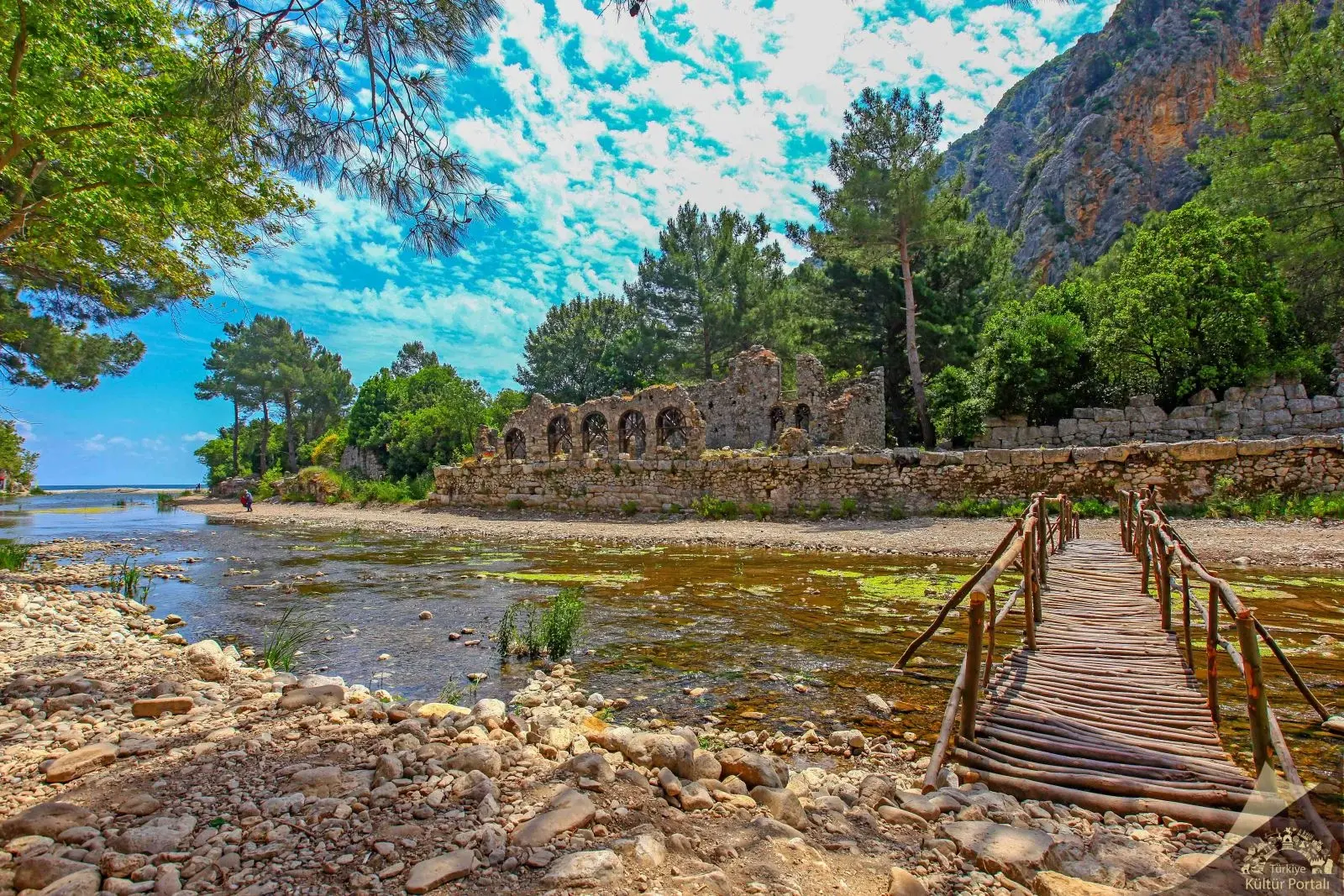
Few places on the Turkish coast put three genuinely different things in the same afternoon. Olympos gives you ancient ruins buried in a river valley, a wild beach that has never had a hotel built on it, and a hillside where natural gas fires have been burning out of the rock for over two thousand years. If you’re staying in Antalya or Kemer, visiting Olympos is one of the better days you can spend in this region.
This guide covers what Olympos is, what you’ll find there, how to reach it, and whether a day trip is enough or you’d be better off staying overnight.
What Is Olympos, Turkey?
Olympos is an ancient Lycian city on Turkey’s Mediterranean coast, set within the Olympos Beydağları National Park about 80 kilometres southwest of Antalya. The name Olympos was common in the ancient world — there were several cities by that name — but this one is distinguished by its location: the ruins run along a narrow river valley that opens directly onto the sea, with forest pressing in on both sides.
The site was inhabited from at least the second century BC through the Byzantine period. The Lycians, Romans, and later Byzantine settlers all left traces here. After being abandoned, the jungle largely reclaimed it. Today the ruins and the valley are a national park. There are no hotels on the beach, no development inside the protected zone, and a single dirt track runs through the ruins to reach the sea.
The village of Olympos sits just outside the park boundary. It’s known in particular for its treehouse and bungalow accommodation — a backpacker culture that developed in the 1990s and remains. If you’re not staying overnight, you’ll pass through the village on the way in and pay an entrance fee at the gate.
What to See: The Ancient Ruins
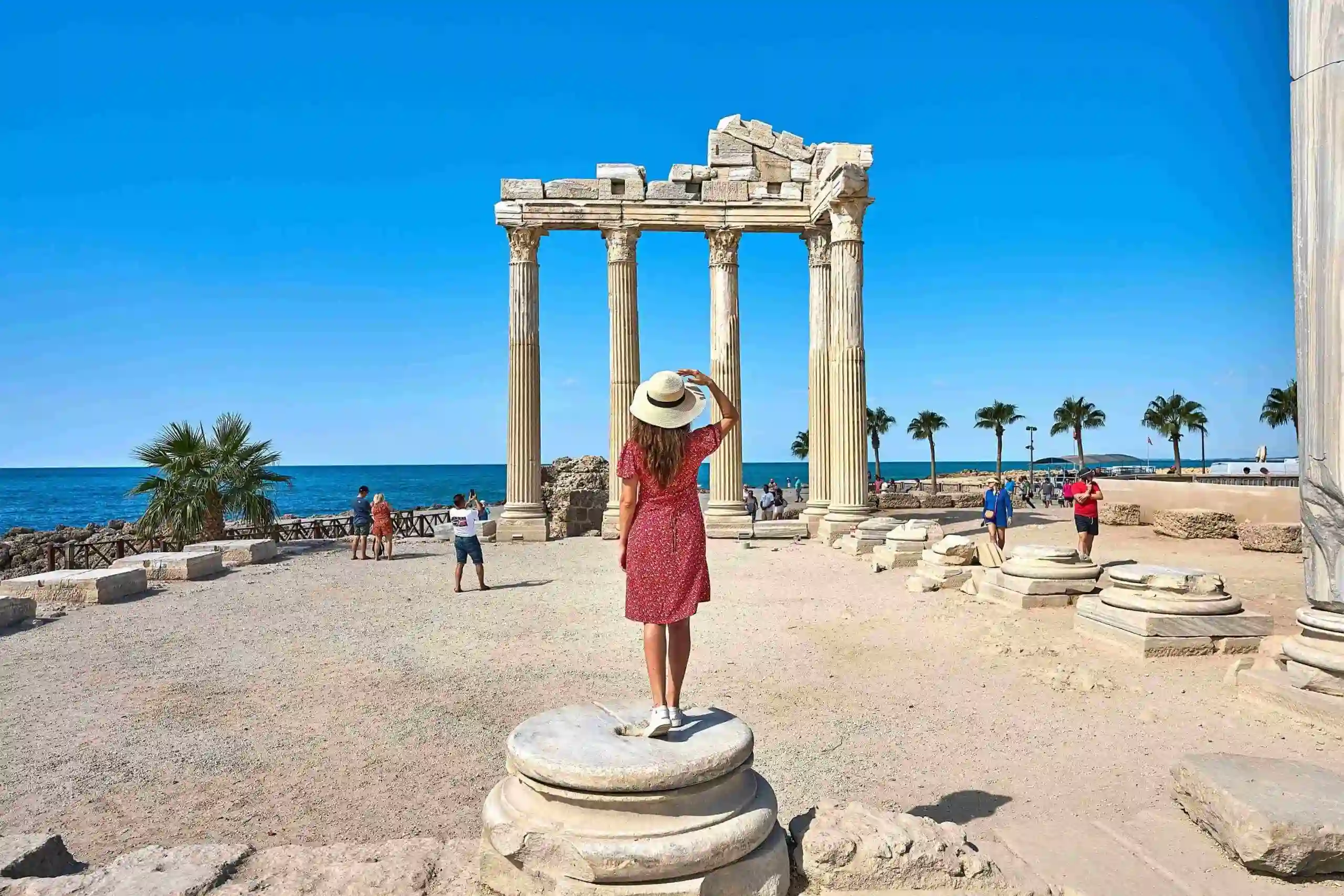
The ruins of Olympos are unusual because they’re not arranged on open ground. You walk through them along a river path, with pine trees and oleander growing between the walls. A Roman gateway, the remains of a basilica, mosaic floors, and carved sarcophagi appear and disappear as you follow the track toward the beach.
The site is roughly divided by the river. The main ruins are on the south bank; there are further remains on the north side as well. Unlike more formally presented sites such as Side or Aspendos, Olympos has an overgrown quality that some visitors find more atmospheric, and others find confusing. There are no audio guides and signage is limited. What you get is a ruin in a forest, which requires no interpretation.
The walk from the entrance gate to the beach takes 15-20 minutes at an easy pace. Most of the significant structures are visible along this route. Entrance is paid at the main gate and covers both the ruins and access to the beach.
Olympos Beach: What to Expect
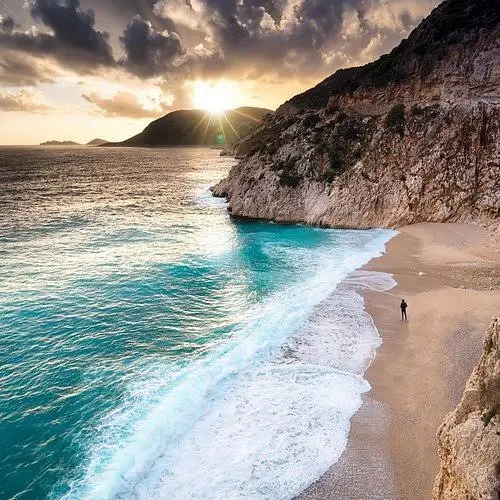
The beach at Olympos is at the far end of the river valley, where the river meets the sea. It’s a long shingle and coarse sand beach in a natural bay, backed by cliffs and forest. There are no sunbeds for hire, no umbrellas, no waterfront restaurants. There’s a basic café near the beach entrance; bring what else you need.
The water is clear and the bay is reasonably sheltered. It’s a good swimming beach. The lack of facilities is part of why it remains in this condition — the national park designation restricts what can be built. Whether you see this as a feature or an inconvenience depends entirely on what you’re looking for.
In summer the beach gets crowded, especially in July and August when tour groups and independent travellers converge. Earlier in the season — May, June, early September — it’s noticeably quieter.
—
Mount Chimaera (Yanartaş): The Eternal Flames
Yanartaş is a separate visit, usually done in the evening because the flames are more visible after dark. It’s a hillside roughly five kilometres from Olympos village where natural gas seeps through fissures in the rock and burns continuously. The Greek myth of the Chimaera — the fire-breathing creature slain by Bellerophon — is thought to have originated here.
There are around 20-30 individual flames spread across the hillside, ranging in size from small flickers to larger jets. Ancient sailors reportedly used the flames as a navigational marker. The walk up from the car park takes about 25 minutes on an uneven path. Take a torch and wear shoes with grip.
Yanartaş is open in the evenings. Entry requires a separate ticket from the Olympos ruins. If you’re visiting both on the same day, plan to do the ruins and beach during the day and return for Chimaera after sunset.
How to Get to Olympos from Antalya
Olympos is approximately 80 kilometres from Antalya city. From Kemer, the nearest significant town, it’s about 30 kilometres. The entrance road descends steeply into the valley from the coast road (D400).
**By tour:** The easiest option if you’re based in Antalya, Kemer, or Belek is an organised day trip with hotel pickup. We run an [Olympos Cable Car Tour from Antalya] that takes you to the Tahtali summit (2,365m) above Olympos with hotel transfer included. For a combined day that pairs the cable car with Antalya city sights, the [Antalya City Tour with Cable Car] covers both. See our full [Olympos tours page] for all options departing from the region.
**By car:** Driving from Antalya takes around 1.5 hours. From Kemer, it’s about 45 minutes. The final descent into the valley is steep and narrow. Parking is available at the entrance gate. The ruins entrance fee is paid on arrival; Yanartaş has its own ticket window near the car park below the hillside.
**By public transport:** Minibuses (dolmuş) run from Kemer to Olympos village. From Antalya, you’d take a bus to Kemer first and then change. This works fine but adds significant time each direction.
If you’re based in Kemer, Olympos is the easiest day trip available. For [Kemer tours] including Olympos and nearby sites, see our Kemer hub page.
When Is the Best Time to Visit Olympos?
The ruins and Yanartaş are accessible year-round. The beach season runs from May to October.
| Month | Conditions | Crowds | Notes |
| March-April | 18-22°C | Low | Ruins excellent; beach cold for swimming |
| May | 23-25°C | Low | Good for ruins + beach; quiet |
| June | 26-28°C | Low-Medium | Best balance — warm water, manageable crowds |
| July-August | 30-35°C | High | Peak season; beach crowded midday |
| September | 27-29°C | Medium | Excellent; water still warm, fewer people |
| October | 22-25°C | Low | Good; some beach days still possible |
| November-February | 12-18°C | Very low | Ruins and Chimaera only; beach not suitable |
For most visitors, **May, June, or September** are the best months. The ruins are worth seeing even in winter, and Yanartaş is arguably more dramatic on a cold clear night than a hot summer one.
If you’re focused on swimming, the season is May-October. If ruins and Chimaera are the priority, any time of year works.
Day Trip vs Overnight: Which Is Right for You?
**Day trip:** A day trip from Antalya is enough to cover the ruins, the beach, and — if you plan it well — Yanartaş in the evening before heading back. It’s a long day, especially from Antalya (3+ hours of driving total), but manageable. From Kemer, it’s much easier.
Most organised day tours focus on either the ruins and beach, or the cable car at Tahtali mountain, rather than all three elements. If you want ruins + beach + Chimaera in one day, you’ll likely need your own transport and a late departure.
**Overnight:** Staying in the village puts you at the ruins at opening time, before tour groups arrive. The Chimaera is straightforwardly accessible in the evening. The bungalow and treehouse accommodation in Olympos village tends to be inexpensive. Some travellers stay two nights to use Olympos as a base for exploring the surrounding coast.
If you only have one free day and are based in Antalya, a day trip is practical and worthwhile. If you have two days to spare, staying overnight improves the experience significantly.
Olympos Tours from Antalya
ADT runs two cable car tours from Antalya that include the Olympos area:
**Olympos Cable Car Tour** — Transfer from your hotel to the Tahtali cable car base, 4.35km ascent to 2,365m on one of the world’s longest cable cars, time at the summit, return transfer. Hotel pickup from Antalya, Kemer, and Belek. Ticket included. No deposit; pay on the day.
**Antalya City Tour with Cable Car** — Full-day tour combining the cable car with Düden Waterfalls, a Mediterranean boat trip, and Kaleiçi Old Town. Better if you want to cover multiple Antalya highlights in one day.
If you want to visit the Olympos ruins and beach directly rather than the cable car, the best approach is self-drive or taking a local minibus from Kemer.
Frequently Asked Questions
Yes, if you’re looking for something different from resort beaches and organised tourist sites. The ruins are atmospheric and the beach is genuinely unspoiled. If you’re staying in Kemer, it’s an easy day trip. From Antalya, it’s further but still manageable in a day.
Yes. There’s a fee at the main gate that covers the ruins and beach access. Yanartaş has a separate ticket. Both are modest. Prices are set by the national park authority and adjusted periodically — check current rates when you arrive.
Yes. The beach has clear water and is suitable for swimming from May through October. There are no sunbeds or umbrellas for hire. The bay is reasonably sheltered and the water is calm on most days.
Yanartaş is open in the evenings. It’s worth timing your visit to arrive around or just after sunset so the flames are visible against a darkening sky. Check locally for current opening hours as these can vary by season.
A half day covers the ruins and beach. A full day lets you add Yanartaş in the evening without rushing. If you want to do all three comfortably, arrive at the ruins when they open and plan to stay until after dark.
The ruins walk is flat and easy. The beach suits all ages. Yanartaş involves an uneven uphill path in low light — manageable for older children but needs care with young ones. Bring a torch and appropriate shoes for the evening visit.