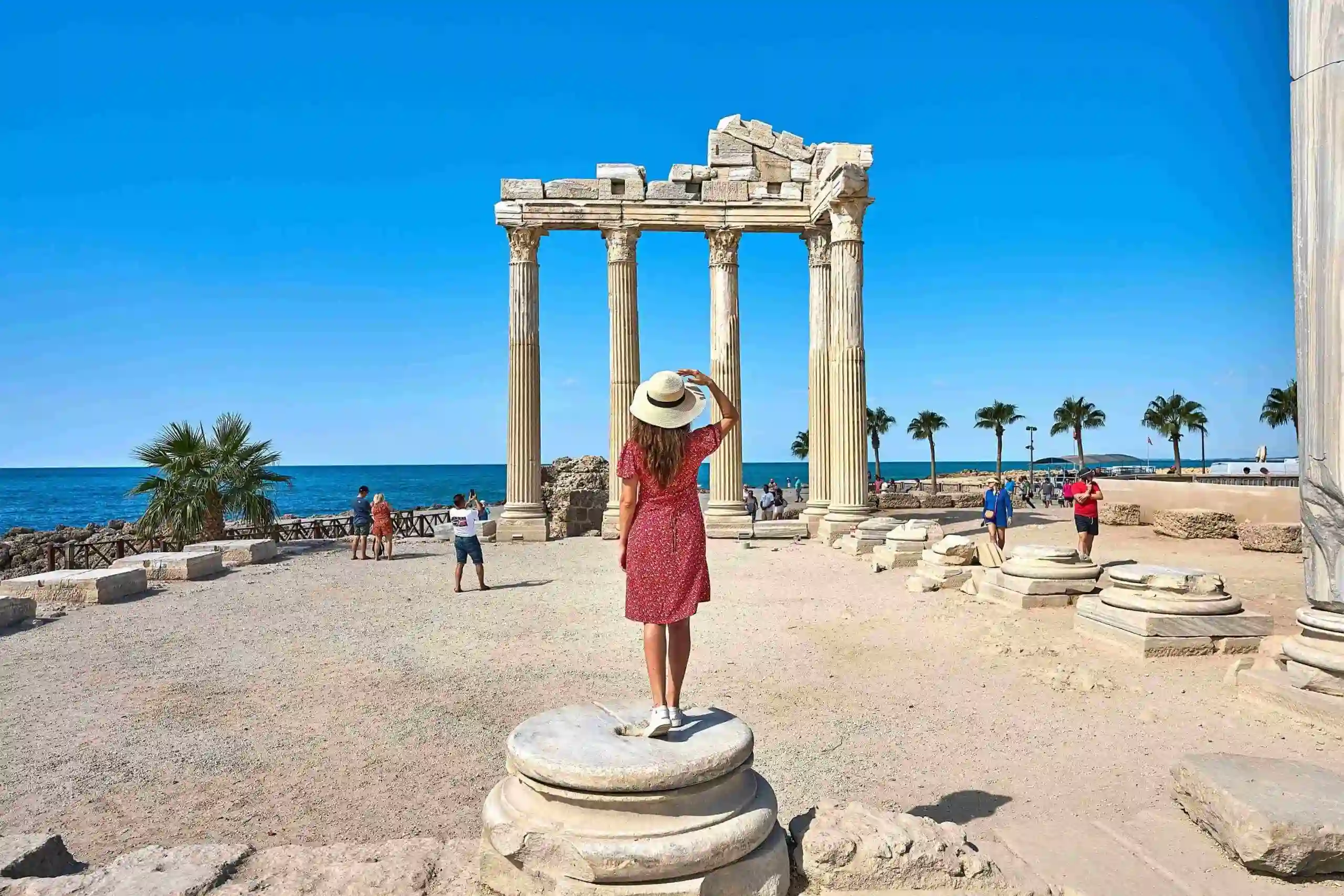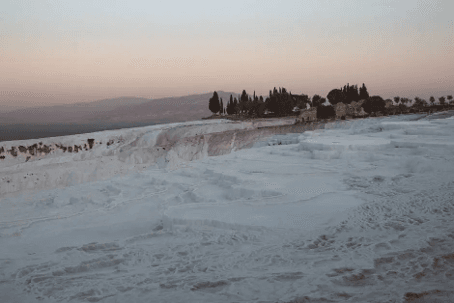
Most tour operators selling Pamukkale from Antalya describe it as a “full-day experience.” That’s accurate, but not quite complete. The drive from Antalya is 230 kilometres each way, which means roughly three hours in a vehicle before you see a single travertine terrace. Factor in the return and you’re looking at six hours of travel around a site visit.
That’s not a reason to skip it. Pamukkale is genuinely one of the most unusual places in Turkey, and if you have a free day and patience for the journey, it’s worth the effort. But you should know what you’re committing to before you book.
This guide covers what Pamukkale actually is, every way to get there from Antalya, what to see when you arrive, and whether a day trip makes sense or you’d be better off staying overnight.
What Is Pamukkale and Why Do People Visit?
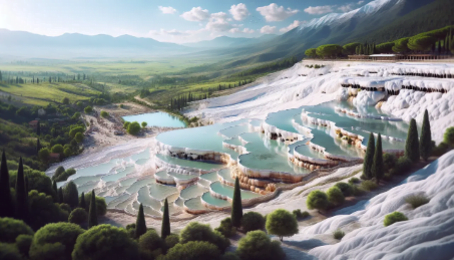
Pamukkale (pronounced pam-uk-kah-leh) means “cotton castle” in Turkish, which describes the view from a distance: a white hillside of calcite terraces in the Denizli province of southwestern Turkey, about 230 kilometres northeast of Antalya.
The terraces were formed over thousands of years as calcium-rich thermal spring water flowed down the hillside and deposited calcium carbonate. The result is a series of natural white pools and cascades in pale rock, some holding warm mineral water.
The site has two main components that most visitors combine.
**The Travertine Terraces** are the white cascading pools for which Pamukkale is known. Shoes must be removed at the entrance (this is enforced) and you walk the terraces barefoot. The upper pools hold warm water and you can wade in them. The lower terraces are often dry due to water management, but the upper section near the ruins is consistently wet.
**Hierapolis** is the ancient Greco-Roman city built directly on top of the travertines, dating to around 190 BC. The remains include a large theatre, a colonnaded street, temples, and one of the most extensive ancient necropolises in the region. The city was significant partly because the thermal springs were believed to have healing properties, drawing visitors from across the ancient world.
The entrance fee covers both the terraces and Hierapolis.
**Cleopatra’s Pool** (also called the Antique Pool) requires a separate ticket. It’s a thermal swimming pool with ancient Roman columns lying submerged in the water, columns that fell during an earthquake and were left in place. The water stays around 35°C year-round. If you have a full day, it’s worth adding.
—
Getting from Antalya to Pamukkale: Your Options
There is no direct train service between Antalya and Pamukkale. Your three realistic options are an organised tour, the intercity bus, or driving yourself.
Each has different trade-offs on time, cost, and flexibility, which are worth understanding before you decide.
—
By Organised Tour: The Simplest Way
For most visitors staying in Antalya, Belek, or Kemer, an organised day tour is the most practical option. You’re collected from your hotel, the guide handles entrance fees and site orientation, and you return to your hotel in the evening without having to navigate bus connections or parking.
Our [Pamukkale tour from Antalya] covers the travertines, Hierapolis, and lunch at the site, with hotel pickup included. No deposit required — you pay on the day.
A note on timing: most organised tours depart around 06:30-07:00 from Antalya and return around 20:00-21:00. This gives approximately five to six hours at the site, enough to walk the terraces, tour a portion of Hierapolis, and have lunch.
If you’re based in Side or Alanya, the drive to Pamukkale is slightly longer. Plan for around 3.5 hours each way.
—
By Organised Tour: The Simplest Way
For most visitors staying in Antalya, Belek, or Kemer, an organised day tour is the most practical option. You’re collected from your hotel, the guide handles entrance fees and site orientation, and you return to your hotel in the evening without having to navigate bus connections or parking.
Our [Pamukkale tour from Antalya] covers the travertines, Hierapolis, and lunch at the site, with hotel pickup included. No deposit required — you pay on the day.
A note on timing: most organised tours depart around 06:30-07:00 from Antalya and return around 20:00-21:00. This gives approximately five to six hours at the site, enough to walk the terraces, tour a portion of Hierapolis, and have lunch.
If you’re based in Side or Alanya, the drive to Pamukkale is slightly longer. Plan for around 3.5 hours each way.
—
By Bus from Antalya
The bus is the cheapest way to make the journey. It requires more planning but works well for independent travellers.
**Step 1**
Take an intercity bus from Antalya’s main bus terminal (Antalya Sehirlerarasi Otobus Terminali) to Denizli. Multiple operators run this route; journey time is around three to 3.5 hours. Buses depart frequently throughout the day.
**Step 2**:
From Denizli’s bus station, take a dolmus (shared minibus) to Pamukkale village. This takes about 20-25 minutes and runs regularly during daylight hours.
**Return**:
Reverse the same route. Last dolmuses from Pamukkale to Denizli run in the early evening; check the times locally before you start the return trip so you’re not stranded.
**Practical notes**:
You’ll arrive independently, without a guide. The travertines are self-explanatory. Hierapolis has limited signage but is manageable on your own. Budget roughly 600-900 Turkish lira return for bus fares, on top of the site entrance fee.
If doing this as a day trip, leave Antalya early (07:00 or 08:00 at the latest) to give yourself enough time at the site before the return journey becomes complicated.
—
By Car: Driving to Pamukkale from Antalya
Driving gives you the most flexibility, particularly if you want to combine Pamukkale with another stop or stay overnight.
The route from Antalya follows the D330 toward Burdur, then continues west toward Denizli. The road is well-maintained throughout. Google Maps or Waze are reliable for this route.
**Journey time**:
2.5 to 3 hours, depending on traffic and whether you stop.
Parking is available in Pamukkale village near both the lower entrance and the upper (Hierapolis side) entrance. Most visitors park near the village and walk up through the terraces.
If you’re driving back the same day, you’ll leave Pamukkale in the early evening and arrive back in Antalya around 21:00 or later. That’s a long day. Driving up and spending one night in Pamukkale makes the return much more comfortable, and it gives you better access to the site in the early morning before the crowds arrive.
—
What to See at Pamukkale ?
A full day at the site can be structured in several ways. Here’s the approach that works best for most visitors:
**Morning (09:00-12:00)**: Start at the lower entrance and walk up the travertines. Remove shoes at the gate. The main active pools are in the upper section; the walk to the top takes 45-60 minutes at a relaxed pace. Bring a bag for your shoes and be aware that the rock can be sharp in dry sections.
**Mid-morning to early afternoon**: Hierapolis. The theatre is the most impressive structure, well-preserved and large enough to seat around 12,000 people, with views across the valley below. The colonnade and temple ruins run from there toward the northern necropolis, which is extensive and quieter than the main tourist flow. Allow 1.5 to 2 hours for a reasonable circuit of the ruins.
**Afternoon**: Lunch in the village or at one of the restaurants near the lower entrance. Then, optionally, Cleopatra’s Pool with a separate ticket. The pool is warm enough to swim in and the submerged columns are a genuinely strange sight.
**Late afternoon**: Walk back down the terraces or use the upper entrance road if you parked or arrived from that direction.
**What to bring**: Sandals or shoes that are easy to remove. A change of clothes or swimwear if you plan to wade in the pools or use Cleopatra’s Pool. Sunscreen, as the white terraces reflect light significantly. Water and snacks, because the site is large and exposed.
—
Day Trip or Overnight: Which Is Right for You?
Here’s the honest version.
A day trip from Antalya to Pamukkale is possible. It’s a full commitment: roughly six hours of driving, about five to six hours at the site, and you’ll be back at your hotel around 21:00. If you have one free day and Pamukkale is your priority, a day trip is worthwhile.
If you have two free days, staying overnight is a significantly better experience. Pamukkale village has accommodation at various price points. Staying means you can arrive at the site at opening time before the crowds, see Hierapolis without rushing, and make the return drive on a fresh morning.
A family from the UK visiting from Belek told us they left for Pamukkale at 06:30 and returned at 21:30. The site was everything they hoped for. But they wished they’d stayed a night. The children were exhausted by 18:00 and the drive back was hard.
If time is short, the organised tour is the most practical choice: no driving, the guide manages efficiency, and hotel pickup and drop-off are included.
—
When Is the Best Time to Visit Pamukkale from Antalya?
The site is open year-round. Conditions vary significantly by season.
| Month | Temperature | Crowds | Notes |
| March-April | 15-20°C | Low | Terraces wet and full; quiet at Hierapolis |
| May | 22-25°C | Low-Medium | Best overall conditions |
| June | 26-28°C | Medium | Warm; good for pools and terraces |
| July-August | 30-36°C | High | Very hot; arrive before 10:00 or after 16:00 |
| September | 26-29°C | Medium | Excellent; water still warm, fewer visitors |
| October | 20-25°C | Low | Good conditions; Hierapolis particularly pleasant |
| November-February | 8-15°C | Very low | Terraces accessible; too cold for wading |
**For the travertines**:
Spring and autumn are best. July and August are extremely hot, and the white rock reflects and amplifies heat. If visiting in summer, aim for early morning arrival (before 10:00).
**For Hierapolis**:
April to October covers the comfortable range. The ruins are worth seeing in any season, but winter days are short and cold.
**For Cleopatra’s Pool**:
The water is around 35°C year-round, but the air temperature makes it more appealing from May to October.
**From Antalya specifically**:
September is the best month to combine a Pamukkale visit with your Antalya stay. The drive is comfortable, the site is quieter than peak summer, and the water temperature is still good.
—
Frequently Asked Questions about Pamukkale
Approximately 2.5 to 3 hours each way, covering around 230 kilometres. Organised tours typically leave Antalya around 06:30-07:00 and return around 20:00-21:00, giving five to six hours at the site.
Yes, if you have a full day available and are prepared for the journey. The travertines and Hierapolis are genuinely distinctive — there is nowhere else quite like it in Turkey. If you only have two or three days in Antalya and want to stay closer to the coast, there are better options nearer by. But if Pamukkale is on your list, make the trip.
Yes. Shoes must be removed at the entrance to the travertine terraces. This is strictly enforced. Sandals that slip off easily are the most practical choice. Bags are provided for your shoes at the entrance gate.
The site entrance covers the travertines and Hierapolis ruins. Cleopatra’s Pool (Antique Pool) charges a separate admission fee. Both are set by the Turkish government and adjusted periodically — check locally when you arrive for current prices.
In the upper terrace pools, you can wade barefoot in warm mineral water. For actual swimming, Cleopatra’s Pool is the right choice: a proper thermal pool at around 35°C with depth for swimming and ancient columns on the bottom. Bring a swimsuit if you plan to use it.
Our day tour includes hotel pickup from Antalya, Belek, and Side, a round-trip coach, an English-speaking guide, entrance fees to the travertines and Hierapolis, lunch, and return transfer. You pay on the tour day — no deposit required.
—
Plan Your Visit
For a full guided day with hotel pickup and all logistics handled, see our [Pamukkale tours and information page] for all options running from the region.
For all excursions and day trips from Antalya, visit our [Antalya excursions page].